

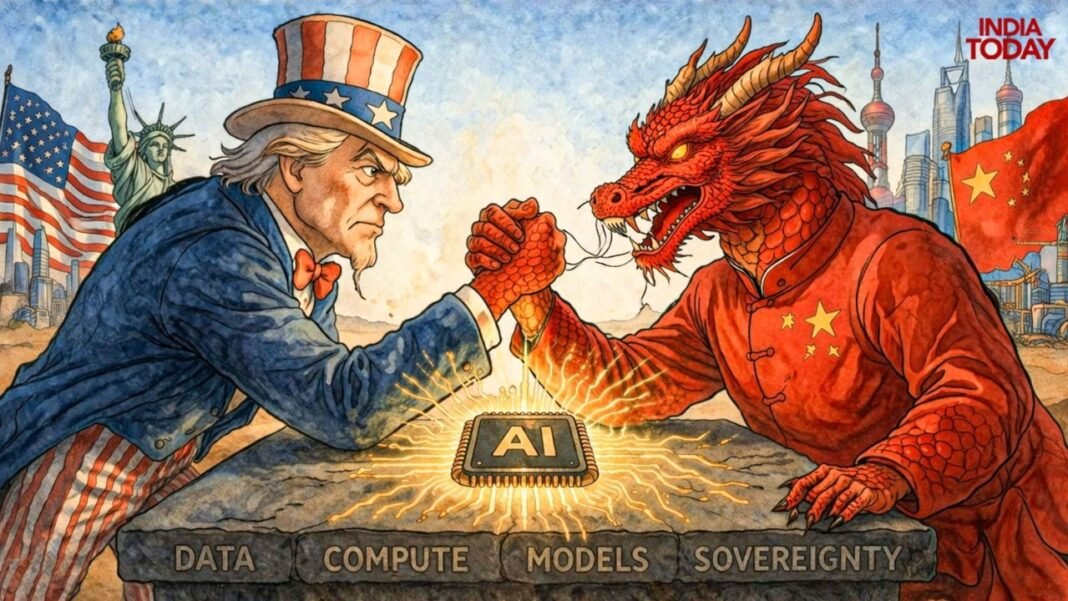

In 2023, the US implemented broad export controls to limit China’s access to advanced AI chips. Shortly after, China ramped up its domestic semiconductor investment reminiscent of Cold War policies and tightened controls over minerals crucial for chip production, like gallium and germanium.
Simultaneously, generative AI systems started performing tasks like drafting legal briefs, diagnosing cancers, coding at a professional level, and influencing political narratives globally.
Throughout history, different eras have had unique power equations. From hulls and cannons in the maritime empires of the 18th century to coal and steel in the industrial states of the 19th century, and the iconic E=mc² of the 20th century. In the 21st century, power is increasingly defined by data (D), computing (C), and models (M), shaping the equation as P = f(D C M).
We are currently witnessing a transition towards algorithmic sovereignty, where political communities can train and deploy advanced AI systems to enhance authority by predicting, modeling, and optimizing various aspects of society using data as the crucial element.
Data, like crude oil, only gains value when refined. In the AI age, the refinement process consists of semiconductor fabrication for advanced chip production, computing infrastructure for handling complex workloads, and model development involving neural networks trained on vast parameters. States mastering these layers will dictate strategic hierarchies.
The competition in AI today differs significantly from past technological rivalries as AI pervades multiple sectors, serving as both infrastructure and weapon, impacting economic, intelligence, and military realms. This necessitates a new approach to handling AI advancements and their potential consequences.
Three main models of sovereign AI development have emerged globally. The American model is decentralized, innovation-driven, and intertwined with national strategies. In contrast, the Chinese model is vertically integrated, state-directed, and deeply connected to political authority. Meanwhile, the European model emphasizes regulation and norm-setting to influence global markets.
India faces structural, linguistic, and institutional challenges in achieving algorithmic sovereignty, requiring sustained investment, linguistic diversity considerations, regulatory stability, and ethical governance frameworks for AI systems.
In conclusion, mastering sovereign AI systems will be crucial for ensuring political autonomy in the evolving landscape where technology and power intersect. The ability to align mathematics with strategy and infrastructure with creativity will redefine the balance of power in the new era.