
Ukraine has leveled accusations of a ‘war crime’ against Vladimir Putin following the launch of a powerful new hypersonic weapon by Russia during recent overnight strikes. The assault carried out by Russia in Kyiv resulted in the deaths of at least four individuals, with additional strikes hitting civilian areas in the Lviv region near the Polish border.
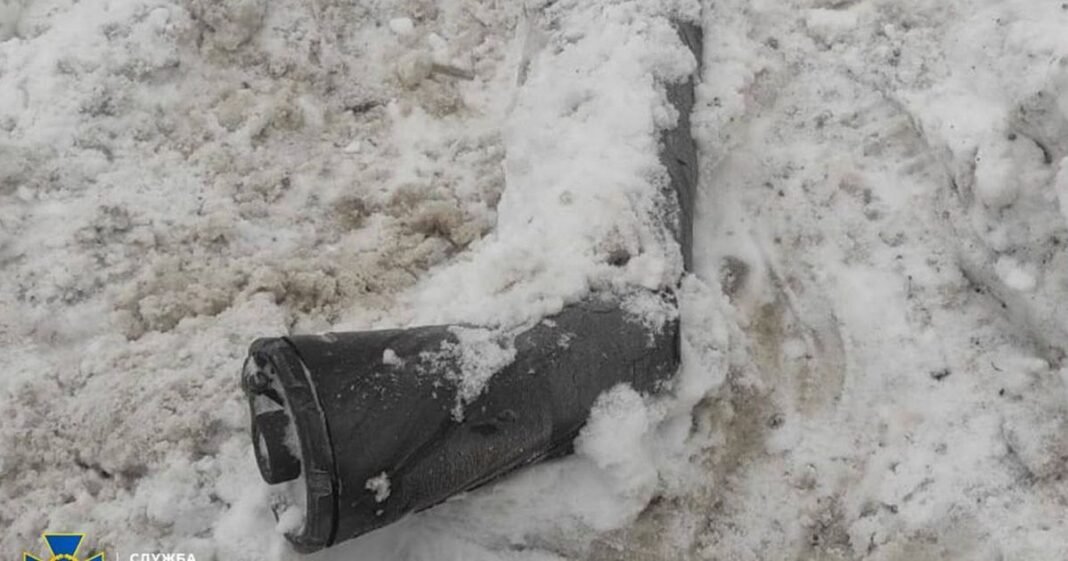
The Ukrainian SBU security service has unveiled images of the nuclear-capable Oreshnik missile discovered in the debris in Lviv, affirming that the use of this weapon is being treated as a war crime. Ukrainian investigators showcased fragments of the missile, including crucial components like the stabilisation and guidance block, responsible for flight control and targeting, engine parts, orientation mechanism fragments, and nozzles from the deployment platform.
Preliminary investigations indicate that the missile was launched from Russia’s Kapustin Yar test site located around 900 miles away. The recovered parts have been classified as evidence and will undergo detailed forensic examination, potentially yielding crucial intelligence on the Russian Oreshnik missile.
The missile was reportedly deployed against civilian infrastructure rather than military targets, exploiting Ukraine’s vulnerable state amidst harsh weather conditions. The assault, which targeted Europe’s largest gas storage facility, coincided with plummeting temperatures reaching -12C overnight. The SBU has accused the Kremlin of aiming to disrupt vital civilian infrastructure near the EU border amid severe weather conditions.
A war crimes case has been initiated by investigators under Article 438 of Ukraine’s Criminal Code, focusing on violations of the laws and customs of war. The Oreshnik missile, touted by Moscow as a cutting-edge strategic weapon capable of carrying nuclear warheads, has been previously used by Russia without explosive warheads, serving as intimidation tools rather than destructive weapons.
While the SBU did not confirm if the missile carried a full warhead, the retrieved fragments suggest a medium-range ballistic strike. The proximity of the strike to the Lviv region, near NATO and EU territories, has raised concerns among Ukrainian officials, who view the attack as a political statement rather than a military advancement. The SBU is actively pursuing all individuals involved in planning and executing the strike to ensure accountability.
In related developments, UK Prime Minister Keir Starmer has engaged in discussions with German Chancellor Friedrich Merz and French President Emmanuel Macron regarding the situation in Ukraine, Greenland, and Iran. The leaders have emphasized the importance of continued coordination with the US to secure a peace deal for Ukraine amidst Russia’s escalating actions, including the recent deployment of an Oreshnik intermediate-range ballistic missile in western Ukraine.