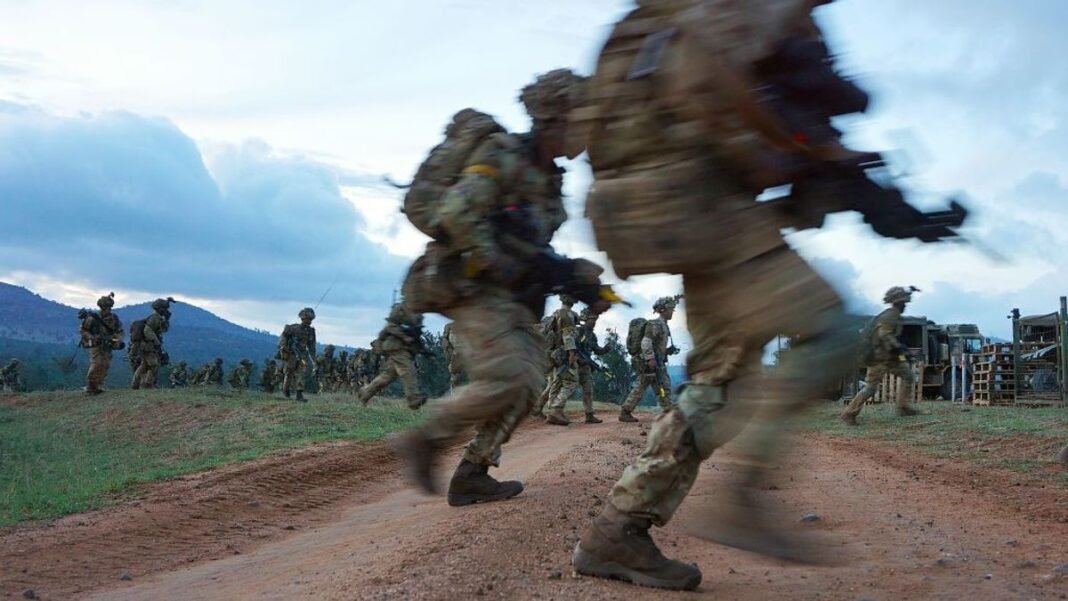

Recent reports have surfaced about the training of young individuals, termed ‘gap year soldiers,’ for potential deployment in conflict zones. The Mirror delves into the potential scenario of conscription in the UK by 2026, offering insights from an expert on the subject.
Scheduled to launch in March 2026, a new initiative is set to welcome individuals under 25 into a gap year military program. This program aims to bolster army recruitment efforts and provide valuable life skills to young adults amidst concerns over geopolitical tensions, particularly related to Russian threats. Inspired by a similar program in Australia, the scheme will initially enroll 150 participants, with aspirations to expand to over 1,000 annually.
Participants will have the opportunity to experience military life and acquire transferrable skills, irrespective of their decision to pursue a full-time military career. While there is no mandatory commitment to long-term service, those opting to remain in the Armed Forces will receive additional training for potential deployment in operational missions.
This development coincides with recent political tensions as Russia rejects peace negotiations in Ukraine and issues threats against British military personnel, escalating fears of potential military confrontations. Prime Minister Keir Starmer and French President Emmanuel Macron have collaborated on a strategic plan to establish military hubs in Ukraine, a move met with opposition from the Kremlin.
Russian officials have expressed concerns over foreign military activities in Ukraine, warning of potential security risks to Russia and other European nations. Against this backdrop, the proposed gap year program has garnered support from experts, with Professor Anthony Glees advocating for a reconsideration of national conscription in response to evolving security challenges outlined in the National Security Strategy report.
While historically contentious, the idea of national conscription has resurfaced due to shifting global security dynamics. Professor Glees underscores the importance of a well-prepared national land army as a deterrent against potential threats, emphasizing the necessity for a comprehensive defense strategy.
The forthcoming gap year program, endorsed by Defense Secretary John Healey, aims to introduce young individuals to diverse opportunities within the Armed Forces, emphasizing skills development and societal engagement in national defense. As discussions around national service resurface, the potential incentives and benefits for participants are being explored to attract a diverse pool of candidates.
The evolving security landscape necessitates a reevaluation of defense strategies, with a renewed focus on conventional military capabilities rather than exclusive reliance on nuclear deterrence. Professor Glees highlights the significance of a strong land army in deterring potential adversaries and safeguarding national interests.
Anticipated to span two years, the new Army scheme will commence with a comprehensive basic training program followed by specialized training in various domains. The Navy and RAF are also exploring similar gap year schemes tailored to enhance skills development and career exploration for young individuals.
Historically, conscription has played a vital role in meeting defense demands during critical periods such as World War I and II. The evolution of national service reflects the evolving needs of defense establishments and the changing societal roles in military service.
In contemporary times, inclusivity and diversity are key themes in the armed forces, with opportunities open to individuals of all backgrounds and genders. The resurgence